4 Types of Writers: What Drives Your Writing Career?
HIT PLAY OR READ THE POST BELOW:
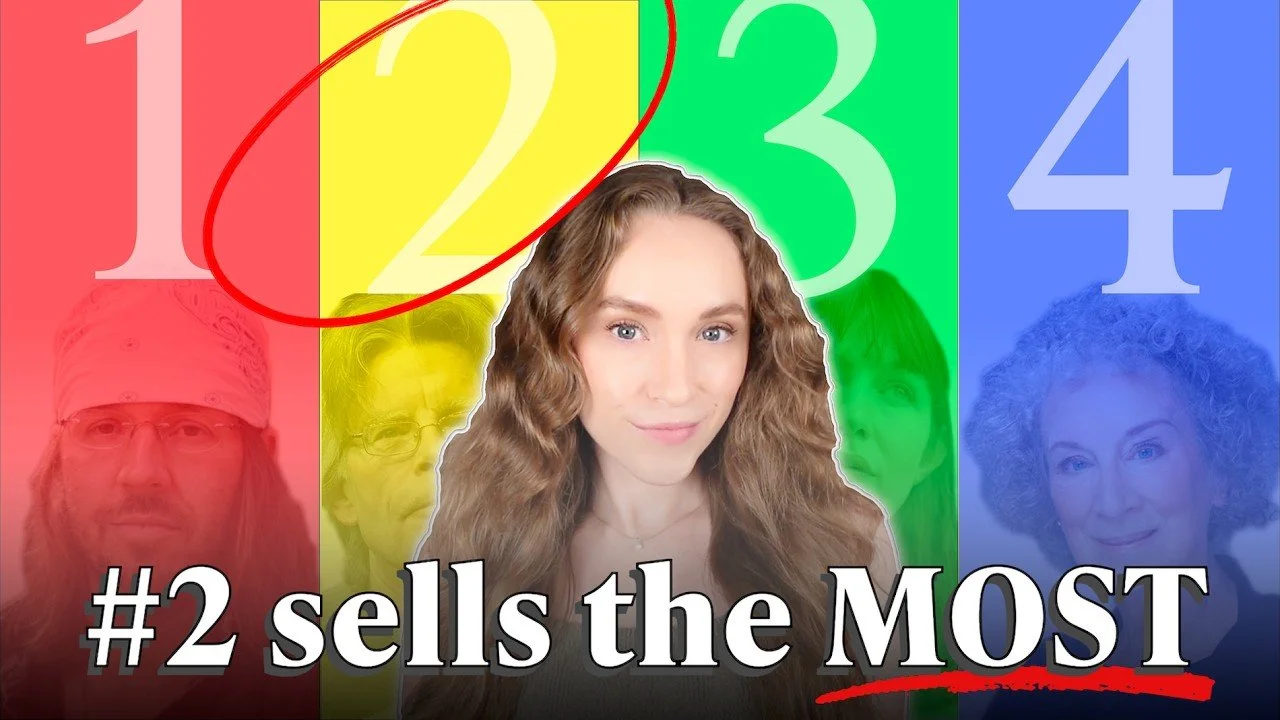
There are four fundamental types of writers, and knowing which one you are can transform your career. As a book editor, I’ve worked with more than a thousand authors across virtually every genre, from sweeping fantasy epics to quiet literary novels. And I’ve noticed that every writer fits into one of these four types, based on your answer to a single question: what drives your writing, deep down?
Your answer doesn’t just shape how you write. It can shape your entire author career, your readership, and even how much money you make. So let’s discover which of the four types of writers fits your personality.
1. The Artist (Types of Writers Who Prioritize Craft)
Of all the types of writers, the artist is driven by the deepest love of the craft of writing itself. If you’ve ever read a novel where every sentence feels like a work of art, you were probably reading something written by an artist-type writer.
Artists obsess over form, style, structure, and language. They are often experimental and willing to take major risks that redefine how we think about a genre or even the novel as a form. Their goal isn’t necessarily to entertain the masses, but to push the boundaries of what literature can be.
The ultimate artist writer is James Joyce. His novels were groundbreaking because they popularized stream of consciousness, allowing readers to experience a character’s internal thoughts as a continuous flow on the page. No one is calling Ulysses a beach read, but his contribution to the literary canon is undeniable.
Another artist from the contemporary era is David Foster Wallace. His novel Infinite Jest is famously more than a thousand pages long and incredibly dense. It includes extensive footnotes, sprawling tangents, and deep dives into the absurdities of modern life. Whether you love it or hate it, it broke countless rules of contemporary literature and continues to spark conversation today.
A more recent example is Ocean Vuong, who is also a poet. His breakout novel, On Earth We’re Briefly Gorgeous, features a lyrical, poetic style. He experiments with epistolary structure and incorporates autobiographical elements throughout the book.
Artist writers often work within literary fiction. These are the kinds of books that go on to win prestigious awards, are taught in classrooms for decades, and sometimes reshape literary history itself.
While the artist may be the platonic ideal among types of writers, the next type might actually be my favorite to work with because they know how to tell a compelling story again and again.
2. The Producer (Types of Writers Who Prioritize Story)
If the artist is obsessed with craft, the producer is obsessed with story.
Producers prioritize plot above all else. Their books keep readers turning pages late into the night and begging for more once they reach the end. They often write genre fiction, including romance, mystery, thrillers, science fiction, fantasy, historical fiction, or young adult.
While an artist might write one or two incredible books, producers tend to be prolific. They find a story formula that works and repeat it successfully. These are the authors with massive backlists whose names regularly appear on bestseller lists.
Agatha Christie is a classic example. She wrote sixty-six detective novels and remains one of the best-selling authors of all time, second only to Shakespeare. Her stories continue to be adapted for film and television because she understood how to engage readers consistently.
Another producer is Stephen King, a name synonymous with contemporary horror and suspense. He creates unforgettable scenarios like a haunted hotel, a demonic clown, or a telekinetic teenager, and readers can’t help but get swept up in his stories. Like Christie, his work has been adapted countless times.
A modern powerhouse producer is James Patterson. He has published hundreds of books across multiple genres, often co-authoring. His short chapters and fast pacing make his novels addictive. He’s built a publishing empire and consistently ranks among the highest-earning authors in the world.
Producers are among the most commercially successful types of writers. They aren’t necessarily trying to become literary icons. Their goal is to give readers a satisfying experience, and when they do that well, the financial rewards often follow.
3. The Psychologist (Types of Writers Who Prioritize Character)
If the artist prioritizes craft and the producer prioritizes plot, the psychologist prioritizes people.
These types of writers are driven by a fascination with character. They ask: who are these people, and what makes them tick? Psychologist writers dive deep into their characters’ psyches, exploring emotional complexity, internal conflict, and complicated relationships. Their novels often read like intimate character studies.
Jane Austen is the quintessential psychologist writer. On the surface, her novels are romances. But what makes them endure is her sharp understanding of human behavior and her ability to translate that insight onto the page. Readers are still obsessed with Elizabeth Bennet and Mr. Darcy because they feel real, even centuries later.
A more contemporary example is Donna Tartt. In The Secret History, there is a murder, but the story isn’t really about solving it. It’s about watching a group of flawed, eccentric students unravel in the aftermath. The characters are the heart of the novel.
Even more recently, Sally Rooney has captivated readers with novels built around emotional intimacy, awkwardness, miscommunication, and longing. Her characters feel deeply authentic, even when they’re deeply flawed. That realism is what keeps readers invested.
Among all types of writers, psychologists excel at crafting characters who linger in the reader’s mind long after the book ends.
4. The Visionary (Types of Writers Who Prioritize Ideas)
Visionaries use stories as vessels for big, thought-provoking ideas. For them, plot and character are tools for delivering a message. They want to comment on the world in a way that inspires, challenges, or provokes readers.
George Orwell is a classic visionary. 1984 and Animal Farm are political allegories that critique authoritarianism, propaganda, and control. His work pushes readers to question the structure of society itself.
Margaret Atwood is another visionary writer. In The Handmaid’s Tale, she created a dystopia where women are stripped of agency in ways that feel disturbingly plausible. The story’s power comes not just from its plot or characters, but from its message.
A contemporary visionary is Colson Whitehead. His Pulitzer Prize–winning novels The Underground Railroad and The Nickel Boys confront the legacy of slavery and systemic racism in America. By blending history with speculative and allegorical elements, he forces readers to face uncomfortable truths about societal oppression.
Visionary writers shape cultural conversations. Of all the types of writers, visionaries are the ones whose books change how we think about the world around us.
Which of the 4 Types of Writers Are You?
Now that you know the four types of writers, consider where you fit. You don’t have to belong to just one category. Many of the strongest writers blend elements from multiple archetypes.
But understanding your natural tendency as a writer can help you see how you fit into the industry and the unique strengths that you bring to your stories.
Looking for an expert developmental editor to strengthen your story?

View more: